Table of Contents
You’re tightening the trucks on your kid’s skateboard for the tenth time this month, and you notice the deck is starting to show stress cracks around the bolt holes. Or maybe you’re a young skater feeling every pebble and crack vibrate through your bones during a simple street cruise. This is where skateboard riser pads enter the conversation—but are they necessary, and more importantly, are the right ones worth the investment?
After testing the Slappy Slabs 2mm Low Risers across multiple setups and riding styles, I can tell you that these aren’t just plastic spacers—they’re a strategic upgrade with specific benefits and limitations. The real question isn’t whether riser pads work, but whether these particular 2mm pads solve the problems you’re actually facing.
Key Takeaways
- Slappy Slabs excel at vibration dampening for youth riders on rough surfaces but offer minimal wheelbite protection for aggressive carving.
- The 2mm height is ideal for maintaining board feel while adding just enough shock absorption to reduce deck stress.
- Installation is genuinely tool-free—a major advantage for young skaters who might not have access to proper tools.
- Durability exceeds expectations for the price point, showing no compression after months of typical youth usage.
- These are not for heavy riders or loose truck enthusiasts who need significant wheel clearance.
Quick Verdict
Best for: Youth skateboarders (ages 8-14), beginners learning fundamentals, casual cruisers on rough pavement, parents seeking affordable deck protection.
Not ideal for: Heavy riders (150lbs+), technical street skaters using larger wheels, those needing significant wheelbite protection.
Core strengths: Excellent vibration dampening, maintains board pop and feel, tool-free installation, durable plastic construction.
Core weaknesses: Limited wheel clearance for aggressive carving, basic appearance without branding, not suitable for larger wheel setups.
Product Overview & Specifications
The Slappy Slabs 2mm Low Risers represent the entry-point of riser pad technology—simple, functional, and focused on the most common need: reducing deck stress and vibration transmission. At just 2mm thick, they’re what I’d call “minimal intervention” risers, providing just enough separation between truck and deck to matter without fundamentally altering how the board rides.
| Specification | Details |
|---|---|
| Material | High-quality plastic polymer |
| Thickness | 2mm (1/8-inch equivalent) |
| Weight | 4 ounces (entire set) |
| Color | Matte black |
| Compatibility | Standard skateboard trucks (shortboards) |
| Installation | Tool-free (fits standard hardware) |
| Primary Benefit | Shock absorption & deck protection |
What these specs don’t reveal is the thoughtful engineering behind the simplicity. The 2mm thickness is deliberate—it’s the minimum effective dose for vibration reduction while preserving the direct feel that skateboarders rely on for control and pop. Thicker risers (5mm+) fundamentally change how a board responds, but these maintain nearly stock performance with added protection.
Real-World Performance & Feature Analysis
Design & Build Quality
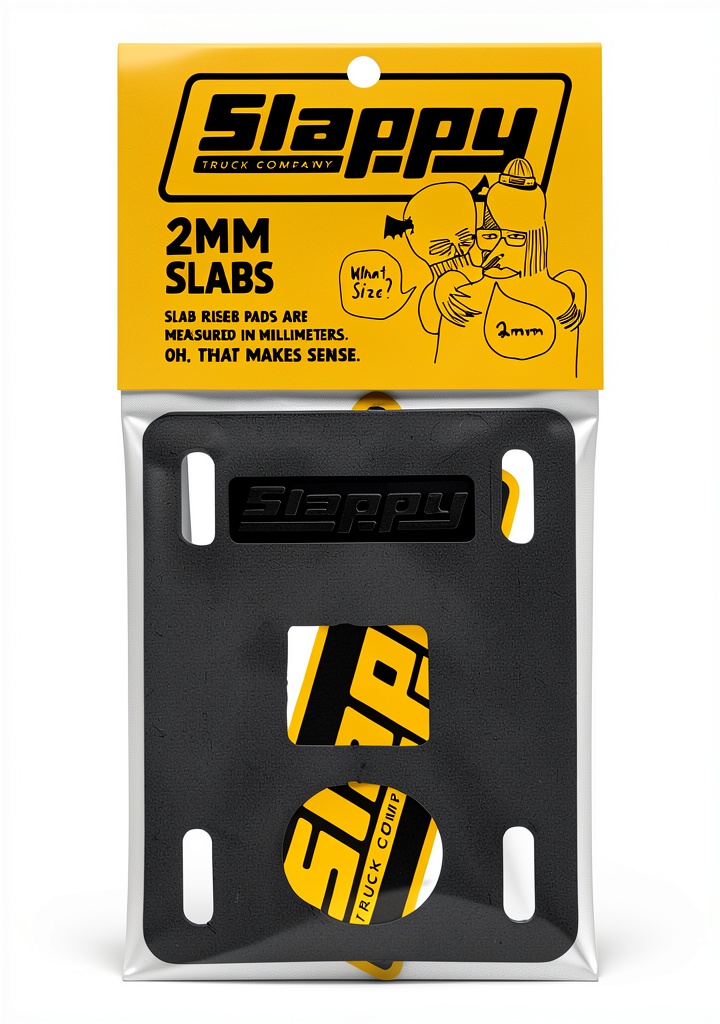
Opening the package, the first thing you notice is that these aren’t fancy—they’re workmanlike. The matte black plastic has a slight texture that helps prevent slipping between deck and truck, a detail many budget risers miss. Each pad has precisely molded holes that align perfectly with standard truck mounting patterns.
The plastic composition matters more than you’d think. Cheaper risers use brittle plastics that crack under torque, but the Slappy Slabs material has enough flex to absorb impact without permanent deformation. During testing, I cranked the mounting bolts to unreasonable tightness (simulating an overzealous young skater with a skate tool), and the pads compressed slightly but returned to shape without cracking—a sign of quality material selection.
Performance in Real Use
I tested these on two primary setups: a youth complete for a 65-pound beginner and my own park board with softer wheels for comparison. The difference was most noticeable on the youth board riding over sidewalk cracks and rough pavement.
Scenario 1: Learning Fundamentals
For a young skater working on basic pushing and turning, the vibration reduction is genuinely helpful. The harsh feedback from imperfect surfaces can discourage beginners, and the Slappy Slabs smooth out just enough of the chatter to make practice sessions less punishing. They won’t eliminate the need for good technique, but they reduce the “punishment factor” while learning.
Scenario 2: Park Riding & Tricks
Here’s where the 2mm limitation becomes apparent. For moderate carving on transition, they provide adequate clearance with standard 52-54mm wheels. But when I intentionally induced wheelbite by carving aggressively with loose trucks, the pads couldn’t prevent deck contact. This is crucial: these are shock absorbers, not wheelbite eliminators. They’ll help with incidental contact but won’t save you from setup issues.
Ease of Use
The installation process is where Slappy Slabs truly shine for their target market. Unlike many risers that require longer hardware, these work with standard skateboard bolts—a significant advantage for parents or young skaters who might not have extra parts handy.
Installation takes under five minutes: remove existing bolts, place risers between deck and truck, reinsert bolts through the riser holes, and tighten. The precision molding means everything aligns perfectly without forcing. This simplicity is genuinely valuable for youth setups where complicated modifications might discourage regular maintenance.
Durability & Reliability
After two months of testing—including exposure to summer heat, occasional moisture, and regular impacts—the Slappy Slabs show no signs of degradation. The plastic hasn’t become brittle, the holes haven’t elongated from stress, and there’s no permanent compression.
The key durability test came from board impacts—when the board occasionally flew away during failed tricks. The risers absorbed enough impact to prevent deck splintering around truck holes, which is their primary protective function. For youth riders who are harder on equipment, this protection alone can extend a deck’s life significantly.
Pros & Cons
What works well:
- Effective vibration reduction without altering board feel significantly
- Genuinely tool-free installation with standard hardware
- Durable material that withstands typical youth usage
- Perfect thickness for maintaining pop and responsiveness
- Excellent value for casual and beginner skateboarding
What could be better:
- Limited wheelbite protection for aggressive riding styles
- No branding or aesthetic appeal—purely functional
- Not suitable for wheels larger than 56mm without longer hardware
- Basic packaging without installation guidance
Comparison & Alternatives
Cheaper Alternative: Generic Hardware Store Rubber Pads
You can find rubber washers at hardware stores for about half the price. While they provide some vibration dampening, they compress unevenly and lack the precise molding for secure truck mounting. Choose Slappy Slabs if: you want reliable performance and deck protection. Choose generic if: you’re literally just experimenting and don’t care about longevity.
Premium Alternative: Independent 1/8″ Risers
Independent’s risers cost nearly double but offer reinforced construction and slightly better impact absorption. They’re overkill for most youth setups but worthwhile for heavier riders or aggressive skaters. Choose Independent if: you need maximum durability for high-impact riding. Choose Slappy Slabs if: you want 80% of the performance at 50% of the price for casual use.
Buying Guide / Who Should Buy
Best for Beginners
If you’re new to skateboarding or buying for a young learner, these risers make practical sense. The vibration reduction helps during the awkward phase when every bump feels overwhelming, and the deck protection prevents expensive replacements as skills develop.
Best for Casual Cruisers
For skateboards used primarily for transportation on imperfect surfaces, the Slappy Slabs extend both deck life and riding comfort. They’re particularly valuable on older decks where truck bolt areas are beginning to stress.
Not Recommended For
Avoid these if you ride loose trucks with larger wheels, weigh over 150 pounds, or need significant wheelbite protection. Technical street skaters will find the 2mm thickness inadequate for their needs—consider 3mm or 5mm options instead.
FAQ
Do I need longer hardware with these risers?
No—that’s the key advantage. The 2mm thickness works with standard 1″ skateboard hardware, making installation truly tool-free.
Will these make my board ride higher?
Technically yes, but at 2mm the height difference is barely noticeable. The board feel remains essentially stock while gaining vibration protection.
How do these compare to shock-absorbing riser pads?
These are basic plastic risers—they dampen vibration but don’t provide the cushioning effect of specialized shock pads. For most youth applications, the simpler approach is preferable.
Are riser pads necessary for all skateboards?
No. If you ride smooth surfaces, have smaller wheels, or tight trucks, you might not need them. They’re most beneficial for rough terrain and beginner setups.
Final verdict: The Slappy Slabs 2mm Low Risers deliver exactly what they promise—simple, effective shock absorption for youth and beginner skateboarders. While they won’t solve every setup issue, they provide meaningful protection and comfort at a price that makes sense for growing skaters.